Top Tips to Stain Your Fence
Key Highlights
- The best time to apply stain to your fence in the Atlanta area is either late spring (after most of the pollen has fallen), or early fall (when temperatures are usually between 50°F & 80°F).
- Staining wood can depend on the type of wood, along with the age of the wood. For example: Pressure-Treated pine wood must have ample time to dry before applying a stain. The “Water Test” can help with this decision.
- Preparing the surface correctly is critical to obtain long term results. Staining the wood that is gray, moldy, and/or oxidized will degrade the protective and aesthetic qualities of the stain.
- In addition, the type of stain chosen is somewhat dependent upon Georgia’s humid climate. Oil-based stains offer good penetration and resistance to decay; however, they do not provide the same level of UV resistance as a water-based acrylic paint finish would.
Stain Your Fence
When talking about how to properly maintain your fence, remember, it isn’t all about making it look nice. Understanding what is meant by Fence Maintenance for Metro Atlanta requires some insight into what these three things are and how they relate to each other. Wood fences can degrade over time due to the amount of direct sunlight, rain, and high humidity Georgia receives.
I, Mr. Jay Fahat, am a specialist in fencing and have extensive experience in fixing and staining fences in Atlanta and Northern Georgia. Many homeowners have sought me out for my expertise and insight regarding how to protect and resurface their fences to make them look great.
You are not alone in the face of this testing period.
At Bravo Fence Company, we provided fencing restoration for many thousands of linear feet over many years and offered our clients different options for stain your fence, from do-it-yourselfers to people who prefer to hire professional help for stain application. We work diligently to ensure that our stains offer an attractive, durable finish to significantly enhance the appearance of your property, whether we are applying it for you or you have chosen to apply it yourself.
To keep your Georgia wooden fence looking its best and protecting it from heat and humidity, use this guide to protect a wooden fence during enumeration from highly skilled professionals in this area.
When is the Best Time to Stain a Fence in Atlanta?
When to apply your sealant. When it’s really warm outside, it causes a flash drying effect on sealant. That will result in paint that has to be peeled. Too wet, and you’ll have an oil/water reaction. Then there is nothing.
Navigating Georgia Weather (Rain & Humidity)
In Atlanta, you have unpredictable weather. You need to have a dry window of time. If possible, it would be ideal to have a “dry window” approximately 24 to 48 hours after completion of fence cleaning and staining application. Main seasons to watch out for include spring, summer, and autumn.
I remember that one project that we handled was that of a fencing company in Marietta, where the owner tried to apply the staining fence in mid-July. At first, the peeling process started to be visible in the fence, considering that the wood was drying quickly in response to exposure to natural light. It seemed to work well in September after adjusting the timing.
When is it too late to stain a fence?
Once temperatures drop to below 50 degrees, the chemistry of the stain will not cure and cure as well (typically late November or early December). With the winter season, you’ll have to wait until spring to apply stain.
The “Water Test” (How to Know It’s Time)
Homeowners typically have several common questions regarding restaining a fence and if staining a brand-new fence is necessary.
- New Fencing: A new fence will include newly treated pressure-treated Pine Fence. The newly treated pressure-treated pine fence absorbs chemical(s) due to the treatment and requires approximately four to six (4-6) weeks for the fence to dry and set completely before applying any stain.
- The Test: Lightly sprinkle the wood with a few droplets of water to help activate the glue for bonding the boards together.
- If it beads up? Sealed and wet wood. Wait.
- If it soaks right away? Well, this is a thirsty wood, and it is now ready to take the stain.
“The staining is not to be performed on wet surface areas, in misty or rainy weather conditions, in snow conditions, or when ice and/or frost are present and visible on the surface.”
—Source: GSA Technical Procedures for Wood Staining.
Choosing the Right Product: Best Stain for Wood Fences
Walking into a hardware store can be a daunting experience as there are so many options available that promise to give your wood the “best protection”. Typically, it’s a decision based on how the wood appears and the status of the wood. The USDA Forest Products Laboratory provides an overview of the finish on your outdoor wood, including specific recommendations.
Oil-Based vs. Water-Based Stains
It is the largest debate associated with wood fence staining.
| Feature | Oil-Based Stain | Water-Based (Acrylic) Stain |
| Penetration | It is extremely penetrating. It is absorbed by the wood fibers to replenish the oils. | It forms a protective layer on top of the wood. |
| Finish | Natural, rich finish. Raises wood grain. | This may look more opaque, like paint, when working with solid colors. |
| Durability in GA | Excellent resistance to moisture and decay. | Has good resistance to UV light, & colors are retained pretty well. |
| Application | Forgiving. Blends out well. | Dries out quickly. More difficult to correct mistakes. |
Transparency Levels
- Clear/Translucent: This is perfect for high-quality wood species like Cedar, as wood grains need to be showcased. This provides least protection from the UV rays.
- Semi-Transparent Stain: This is the best of all. In addition to color (brown, reddish, and so on), which it imparts to wood, it is capable of making the wood grain visible. That is what I would say is the best of both worlds.
- Solid Stain: Paint-like consistency with stain qualities. This kind of best stain for wood fence is most versatile and is best for older wood frame buildings, where you might need to hide some defects.
Staining a Cedar Fence
Cedar is a high-quality wood that contains natural oils that resist rot. However, if cedar is left unstained, it will turn a silvery-gray color within one year. In terms of the type of use for staining a cedar fence, our advice is to apply a semi-transparent, oil-based stain.
Should You Stain a Cedar Fence?
Yes, you should definitely stain your cedar fence. This is because it really protects it from water, sunlight, and the other elements. Also, it prevents it from becoming gray. Apart from that, it also increases its longevity because it is not prone to warps.
One customer in particular in Alpharetta had cedar on his fence. He wanted the reds to come through well in the photographs, so he applied the oil stain in a semi-transparent manner. The results in the last six months indicated that the color on the cedar responded well to the rainfall in the summer.
Preparation is Key to a Long Lasting Finish
You cannot stain a dirty fence. Period. To “stain” mildew, dirt, and that thick coating of Georgia Red Clay Dust, it won’t be long before it flakes right off.
Power Wash Fence Before and After: DOs & DO NOTs
In fact, it has always been perceived that cleaning the fence and staining it is the sole property of waterblast cleaning. This is not correct. In fact, too much pressure will damage the fibers, and the wood looks ‘furry’.
How to Clean Fence Before Staining:
- Chemicals First: Use wood cleaner or bleach solution at a concentration; 1 part bleach to 3 parts water to eliminate organic growth, such as mold and/or algae.
- Low Pressure: The pressure washer should have a broad tip on it, -25 to 40 degrees. Keep the wand in motion and keep the nozzle 12-18 inches away from the surface. The goal is to remove the dirt by not carving the wood.
- Dry Time: This is important. How long does fence stain need to dry before rain? You will want dry weather following staining, but you will want the wood to be dry before starting. 24 to 48 hours of drying following washing.
How to Protect Wood Fence from Weather During Prep
Prior to you starting to spray, tarp off the surrounding plants and grass. This will help prevent overspray from getting on plants that are close by. Plants which come into contact with overspray can be protected by watering them down before and after tasks involving overspray. This will help to prevent overspray.
Staining a Fence: Step by Step Instructions In addition to increasing the
If you have decided to complete this step yourself instead of leasing or hiring a staining firm, here is how you can complete this step efficiently. Additional steps you may want to take within the process of preparing wood before this step can be found at Oregon State University Extension.
1. Equipment Needed
A brush would work well too. However, for the average privacy fence, this would take days.
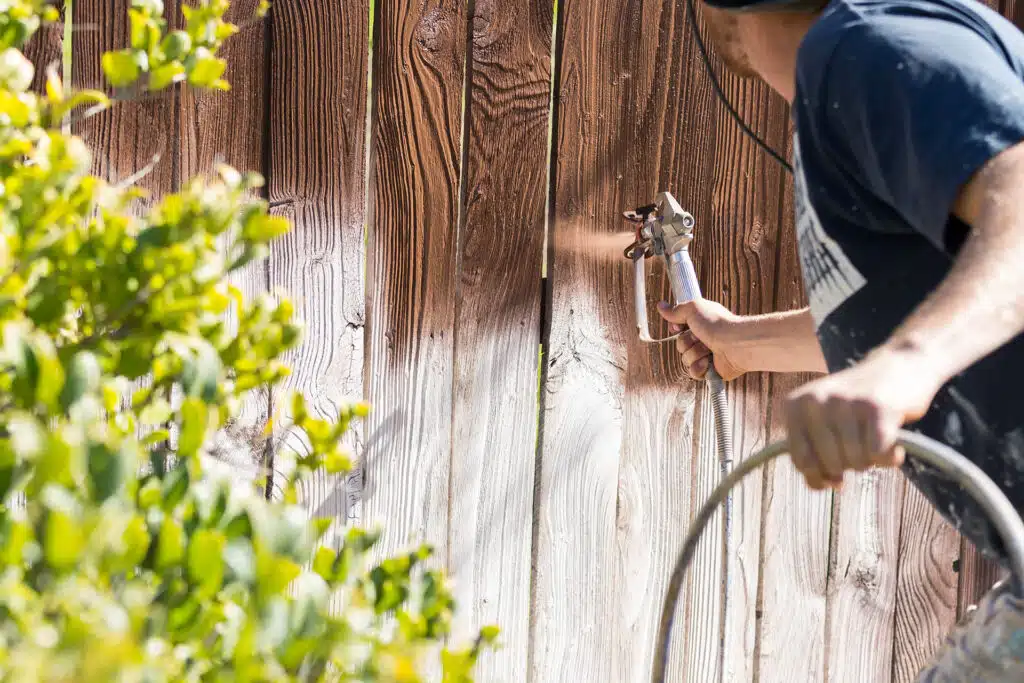
- Best Fence Stain Sprayer: For professional staining, you will want to utilize the airless sprayer. This may be rented. You will get a fixed fan pattern. Thinning oil stains require that you make use of the pump sprayer intended for gardening. But when it comes to acrylic paint, this spray isn’t very helpful.
- Roller/Brush: You’ll still need these for back brushing.
2. The “Back-Brushing” Technique
The best way to apply stain to a fence, if the life of the fence is to be long, is by a specialist who comes with all sorts of tools.
Mist onto the stain, immediately following by a brush or roller over the wet surface. The stain then will be forced into the pores of the wood, rather than applying a layer to the surface of the wood.
3. Attack the End Grain
The tops and bottoms of your vertical pickets are straws, essentially, for sucking up water from rain and the ground. Now, when you’re staining a wood fence, you have to saturate these parts.
4. Work in Sections
Do not try to complete the fence before you begin to “back brush.” The stain will be too dry. Spray 10-foot sections. If you are applying a privacy fence stain, finish a panel before starting a new one.
QTY & Cost: Planning for the Project
Running out of stain at the wrong time in the panel is a nightmare because the batches of colors may vary very slightly for each can.
Calculating Amounts for Fence Stain If you’re staining your fence for the first
The amount of gallons of stain that are used in fencing projects. The calculation is as follows:
Average coverage rate is 150 to 200 sq. feet per gallon.
- Formula: (Fence Length x Fence Height) x 2
- Rough Surface Factor: Poreous and mature wood will accept stain at a higher rate. Coverage rate: 125 sq. ft. per gallon.
- Smooth Surface Factor: “Newer wood goes farther.”
You can hire a fence stain company to ensure that there is an even application for you and to avoid any back-breaking work.
Is your fence tired-looking?
Don’t wait for the wood to rot. Call Bravo Fence Company today. We are the fence stain company near me Atlanta, people search for and trust for restoring gray wood to gold.
Mistakes Made While Staining Your Fence: Common Mistakes
We might be asked, at times, to correct poor home renovation work. The mistakes that we must avoid making are these:
- Staining Damp Wood
- Missing the Clean
- Painting One Side
- Applying Interior Furniture Stain
Preserve Your Fence with Bravo Fence Company Today
A fence can easily define boundaries of your property; a fence can equally give you the privacy of those who matter most to you. However, in the state of Georgia, sun exposure, rainwater, or mere humidity will bring you a costly nightmare if you fail to address the problem of a fence.
Whether it be power washing or hiding your property, at Bravo Fence Company, we have expertise with fence staining and utilize a large understanding of your local environment here in Atlanta to combine with high-quality materials that make your fence pleasing to the eye for years to come.
Start with a quality and attractive fence.
Start protecting your staining investment today. Call us at (770) 966-9970 to schedule your free consultation and see how our experts can transform your fence.
Frequently Asked Questions
1. How long does it take to stain a fence?
For a professional installation, it will require the average backyard for two days: Day 1 for cleaning the surface, while Day 2 will be for staining the surface once it is dry. For a DIY person, it will require two weekends.
2. How often should you stain your fence?
For Atlanta, you can reckon for translucide a 2 to 3 year refresh cycle, a 3 to 5, while opaque can last around 5 to 7 years. The only problem with the opaque ones when reapplied is removal.
3. How to stain a fence with a roller?
Use a thick nap roller (¾ inch) to get into the texture of the wood. But the rollers won’t reach between the pickets. That’s where the brush comes in.
4. How much to stain a fence (Cost)?
The prices differ in accordance with the condition of the wooden material and its length; however, professionally staining fences is an outlay that will cost you much less than replacing rotten fences.
5. How to stain wood fence that is old?
You might have to use a “wood brightener” on the wood surface, subsequent to cleaning. The wood brightener helps to remove any residue of the cleaning agents, leaving the wood surface with a non-acidic pH and making the wood surface brighter before the final staining process.